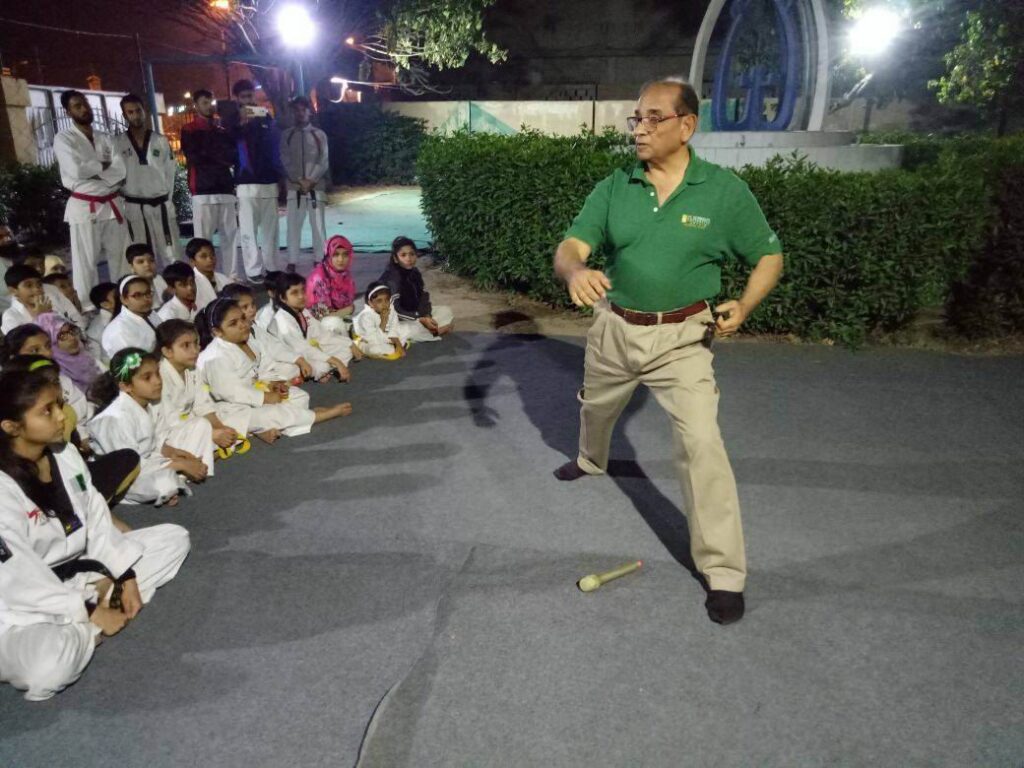
First published in the December 1975 issue of Black Belt, Richard Hirneisen’s contemporary profile records the early history of taekwondo in Pakistan through the work of Saleem Jehangir. It traces Jehangir’s training under Hwa Chong at the University of Michigan, his return to Karachi in 1971, the first formal class at the National Sports Training and Coaching Centre (NSTCC), and the rapid national growth that followed.
“I plan to have the youth follow me in a fight to construct the nation, rather than destroy it.”
— Saleem Jehangir, 1975
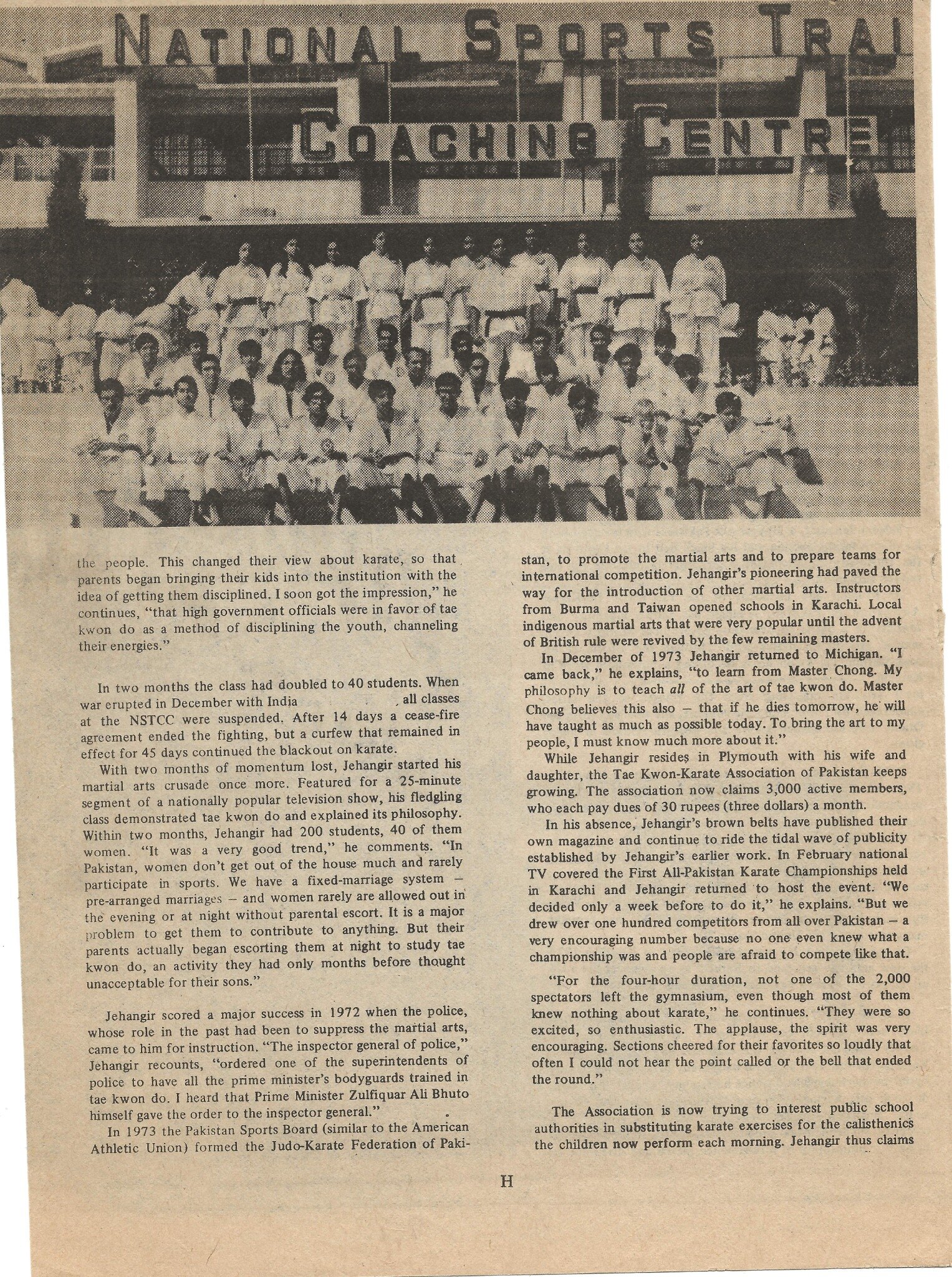
Photographic note: The photographs below have been isolated from the surviving magazine pages so that the story reads as an illustrated web article rather than a facsimile. Later photographs from the Kangdukwon archives in Pakistan show the movement that grew from this early work.
The first generation in Pakistan
Searchable transcription
Pakistan: Magic Carpets and Martial Arts
By Richard Hirneisen
Four years ago, the martial arts in Pakistan were dying. Considered by scholars to be the ancient birthplace of the martial arts, the India-Pakistan subcontinent had been subject to British colonial rule since 1707.
During that period all fighting arts were severely curtailed and by the time of India-Pakistani independence in 1947, there were no formal martial arts schools. Only a few masters, usually hidden in remote villages, hung on to the old traditions, teaching a handful of students the intricacies of such martial esoterica as axe and stick-fighting and a form of wrestling similar to sumo. The empty-handed forms of combat had completely vanished.
But recently a remarkable renaissance began in Pakistan. The Pakistani government, which formerly prohibited all martial arts, now promotes and may soon help finance them as an asset to the country.
Saleem Jehangir, a 30-year-old Pakistani who received both his degree in engineering and his black belt in tae kwon do at the University of Michigan, is primarily responsible for this sudden turnabout.
As founder and president of the Tae Kwon Do-Karate Association of Pakistan, Jehangir has shown ingenuity and tenacity in a battle to overcome government hostility to the martial arts in his native land. Through the efforts of his organization, tae kwon do is becoming a household word in Karachi, [one short passage is obscured in the surviving scan]. Masters of local arts are migrating from the villages to the cities, encouraged by public and civic support, and teachers from the Orient have established karate and kung-fu schools in major cities.
From Michigan to Karachi
Jehangir’s career in the martial arts began in Karachi in 1965, when he read an article in Life magazine that praised the academic virtues of the University of Michigan. Seeking a degree in engineering, he decided to enroll.
Hwa Chong, a Korean pursuing a master’s degree in economics at the U of M, had just begun teaching tae kwon do in Ann Arbor. Jehangir enrolled in Chong’s tiny class and was soon a star pupil. “It is ironical,” the soft-spoken Jehangir reflects, “that to learn an Eastern art I have come to the West. But such is the way of life. Western affluence has brought many masters to the United States.”
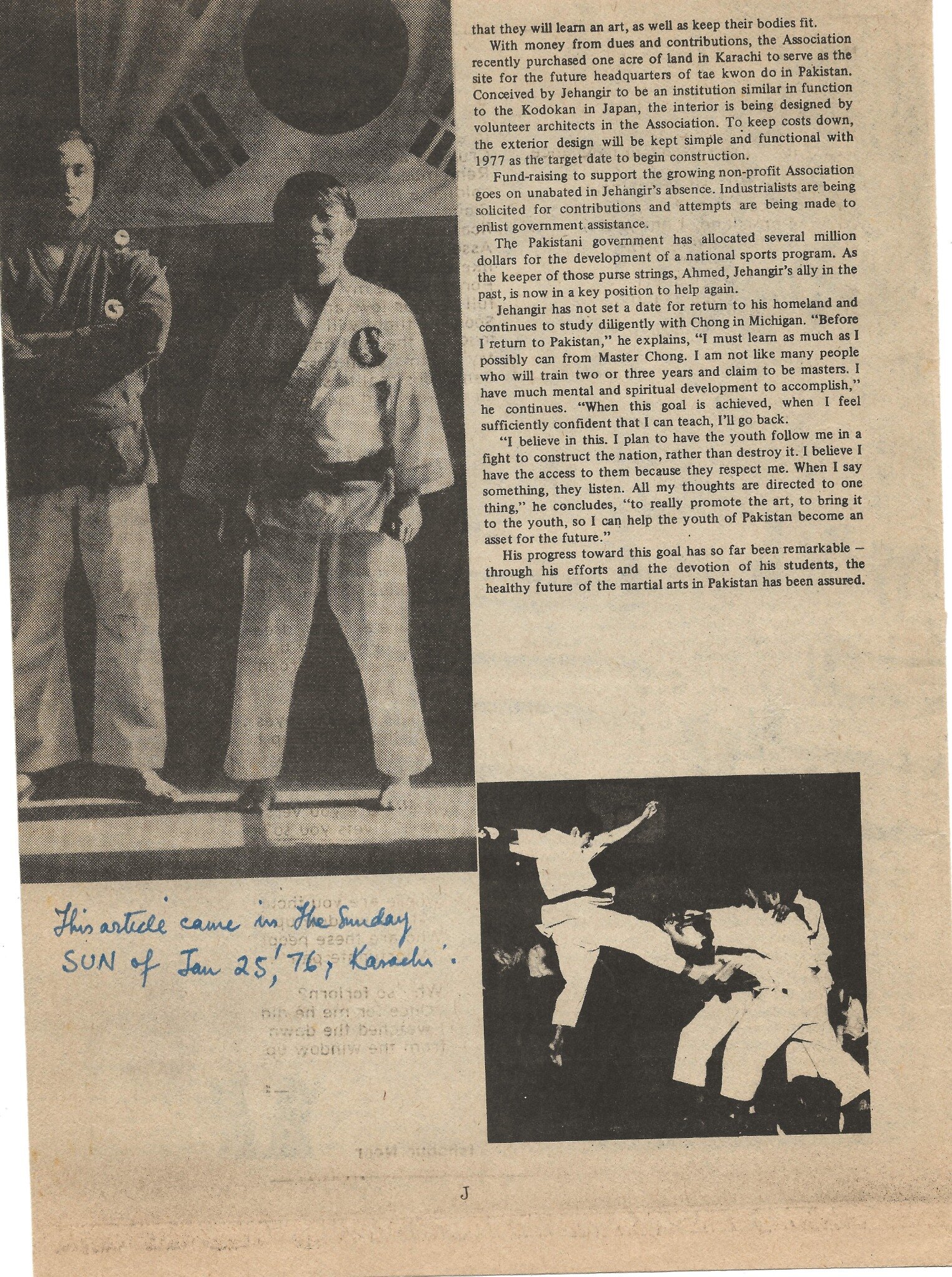
Chong promoted Jehangir to black belt in 1970. In 1971 the new graduate returned to Karachi as an engineer for a U.S. oil corporation with extensive facilities in Karachi.
In October 1971, the young engineer—his country’s first black belt—taught the first karate class held in Pakistan. Twenty students met at the extensive NSTCC facilities in Karachi. Government approval had finally bestowed legitimacy upon the martial arts and police harassment ceased. Tae kwon do took off. Jehangir was soon featured on television shows, sports and news magazines and became something of a celebrity. “Through this publicity,” he recalls, “I was able to bring our philosophy of non-violence, peace and discipline to the people. This changed their view about karate, so that parents began bringing their kids into the institution with the idea of getting them disciplined. I soon got the impression,” he continues, “that high government officials were in favor of tae kwon do as a method of disciplining the youth, channeling their energies.”
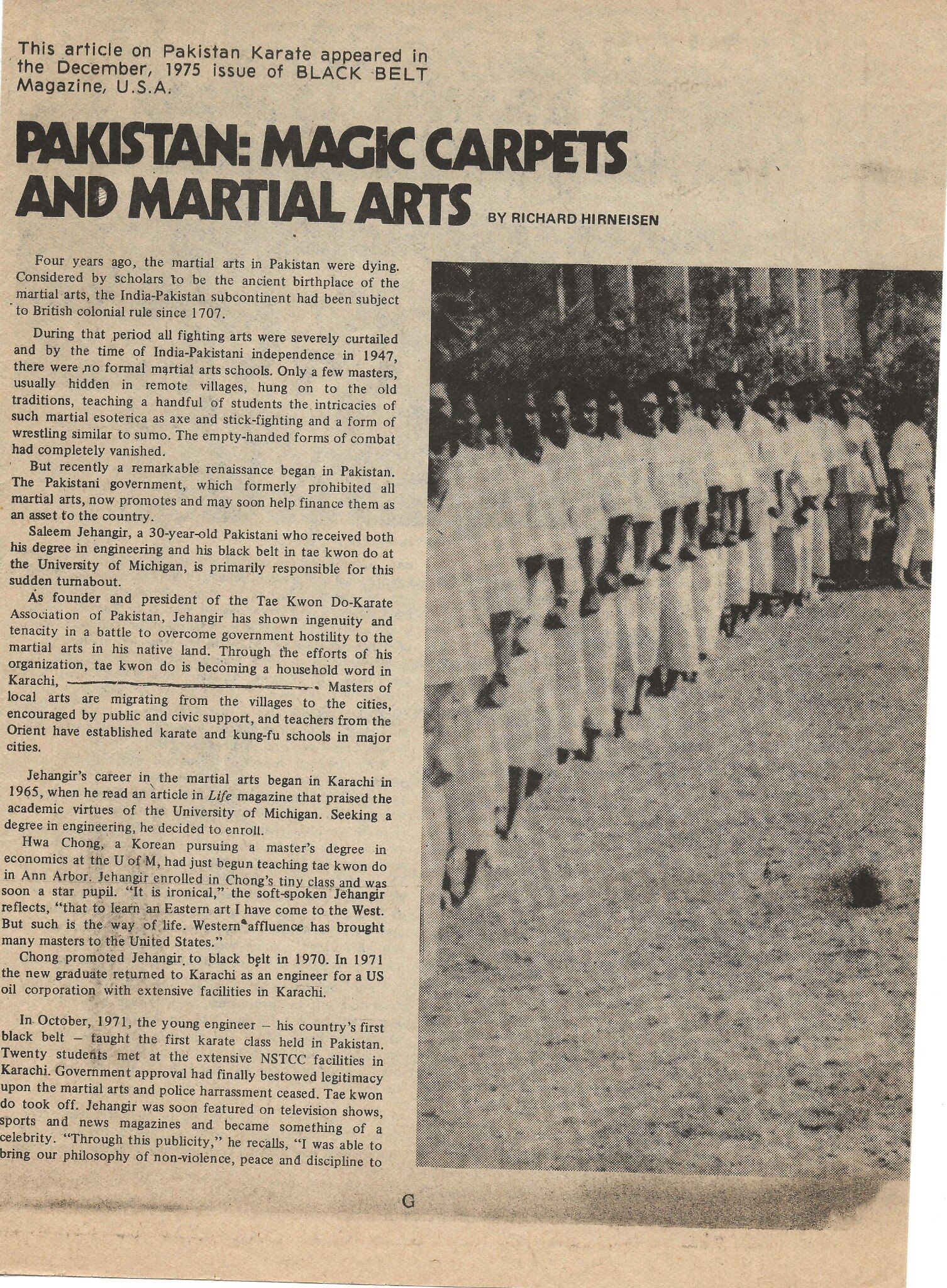
In two months the class had doubled to 40 students. When war erupted in December with India, all classes at the NSTCC were suspended. After 14 days a cease-fire agreement ended the fighting, but a curfew that remained in effect for 45 days continued the blackout on karate.
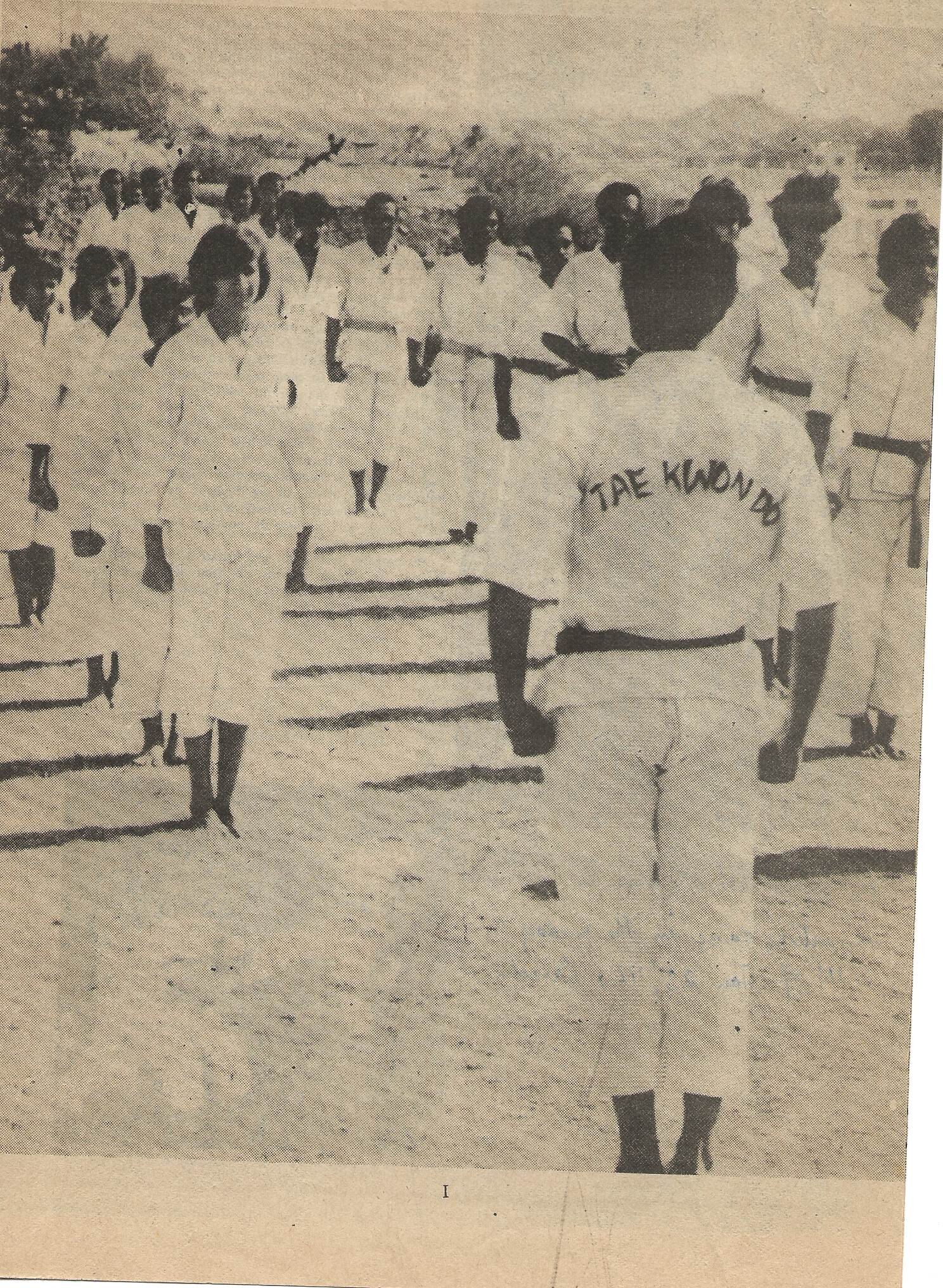
A national movement
With two months of momentum lost, Jehangir started his martial arts crusade once more. Featured for a 25-minute segment of a nationally popular television show, his fledgling class demonstrated tae kwon do and explained its philosophy. Within two months, Jehangir had 200 students, 40 of them women. “It was a very good trend,” he comments. “In Pakistan, women don’t get out of the house much and rarely participate in sports. We have a fixed-marriage system—pre-arranged marriages—and women rarely are allowed out in the evening or at night without parental escort. It is a major problem to get them to contribute to anything. But their parents actually began escorting them at night to study tae kwon do, an activity they had only months before thought unacceptable for their sons.”
Jehangir scored a major success in 1972 when the police, whose role in the past had been to suppress the martial arts, came to him for instruction. “The inspector general of police,” Jehangir recounts, “ordered one of the superintendents of police to have all the prime minister’s bodyguards trained in tae kwon do. I heard that Prime Minister Zulfikar Ali Bhutto himself gave the order to the inspector general.”
In 1973 the Pakistan Sports Board (similar to the American Athletic Union) formed the Judo-Karate Federation of Pakistan, to promote the martial arts and to prepare teams for international competition. Jehangir’s pioneering had paved the way for the introduction of other martial arts. Instructors from Burma and Taiwan opened schools in Karachi. Local indigenous martial arts that were very popular until the advent of British rule were revived by the few remaining masters.
Return to Michigan
In December of 1973 Jehangir returned to Michigan. “I came back,” he explains, “to learn from Master Chong. My philosophy is to teach all of the art of tae kwon do. Master Chong believes this also—that if he dies tomorrow, he will have taught as much as possible today. To bring the art to my people, I must know much more about it.”
While Jehangir resides in Plymouth with his wife and daughter, the Tae Kwon-Karate Association of Pakistan keeps growing. The association now claims 3,000 active members, who each pay dues of 30 rupees (three dollars) a month.
In his absence, Jehangir’s brown belts have published their own magazine and continue to ride the tidal wave of publicity established by Jehangir’s earlier work. In February national TV covered the First All-Pakistan Karate Championships held in Karachi and Jehangir returned to host the event. “We decided only a week before to do it,” he explains. “But we drew over one hundred competitors from all over Pakistan—a very encouraging number because no one even knew what a championship was and people are afraid to compete like that.
“For the four-hour duration, not one of the 2,000 spectators left the gymnasium, even though most of them knew nothing about karate,” he continues. “They were so excited, so enthusiastic. The applause, the spirit was very encouraging. Sections cheered for their favorites so loudly that often I could not hear the point called or the bell that ended the round.”
The Association is now trying to interest public school authorities in substituting karate exercises for the calisthenics the children now perform each morning. Jehangir thus claims that they will learn an art, as well as keep their bodies fit.
A vision for Pakistan’s youth
With money from dues and contributions, the Association recently purchased one acre of land in Karachi to serve as the site for the future headquarters of tae kwon do in Pakistan. Conceived by Jehangir to be an institution similar in function to the Kodokan in Japan, the interior is being designed by volunteer architects in the Association. To keep costs down, the exterior design will be kept simple and functional with 1977 as the target date to begin construction.
Fund-raising to support the growing non-profit Association goes on unabated in Jehangir’s absence. Industrialists are being solicited for contributions and attempts are being made to enlist government assistance.
The Pakistani government has allocated several million dollars for the development of a national sports program. As the keeper of those purse strings, Ahmed, Jehangir’s ally in the past, is now in a key position to help again.
Jehangir has not set a date for return to his homeland and continues to study diligently with Chong in Michigan. “Before I return to Pakistan,” he explains, “I must learn as much as I possibly can from Master Chong. I am not like many people who will train two or three years and claim to be masters. I have much mental and spiritual development to accomplish,” he continues. “When this goal is achieved, when I feel sufficiently confident that I can teach, I’ll go back.
“I believe in this. I plan to have the youth follow me in a fight to construct the nation, rather than destroy it. I believe I have the access to them because they respect me. When I say something, they listen. All my thoughts are directed to one thing,” he concludes, “to really promote the art, to bring it to the youth, so I can help the youth of Pakistan become an asset for the future.”
His progress toward this goal has so far been remarkable—through his efforts and the devotion of his students, the healthy future of the martial arts in Pakistan has been assured.
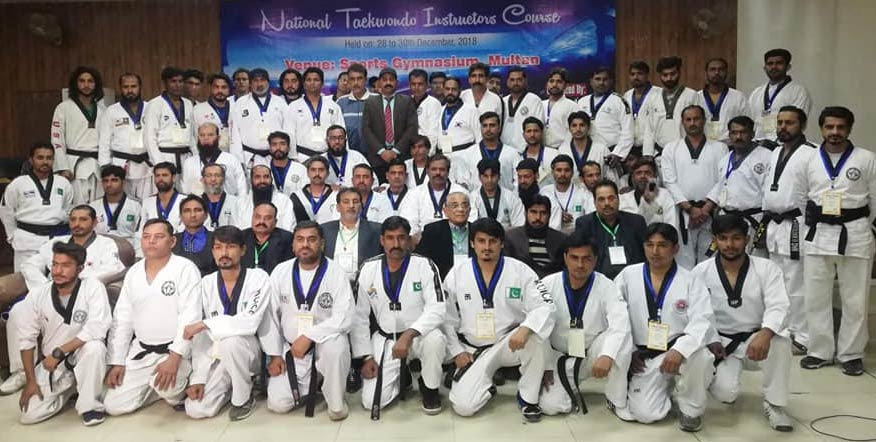
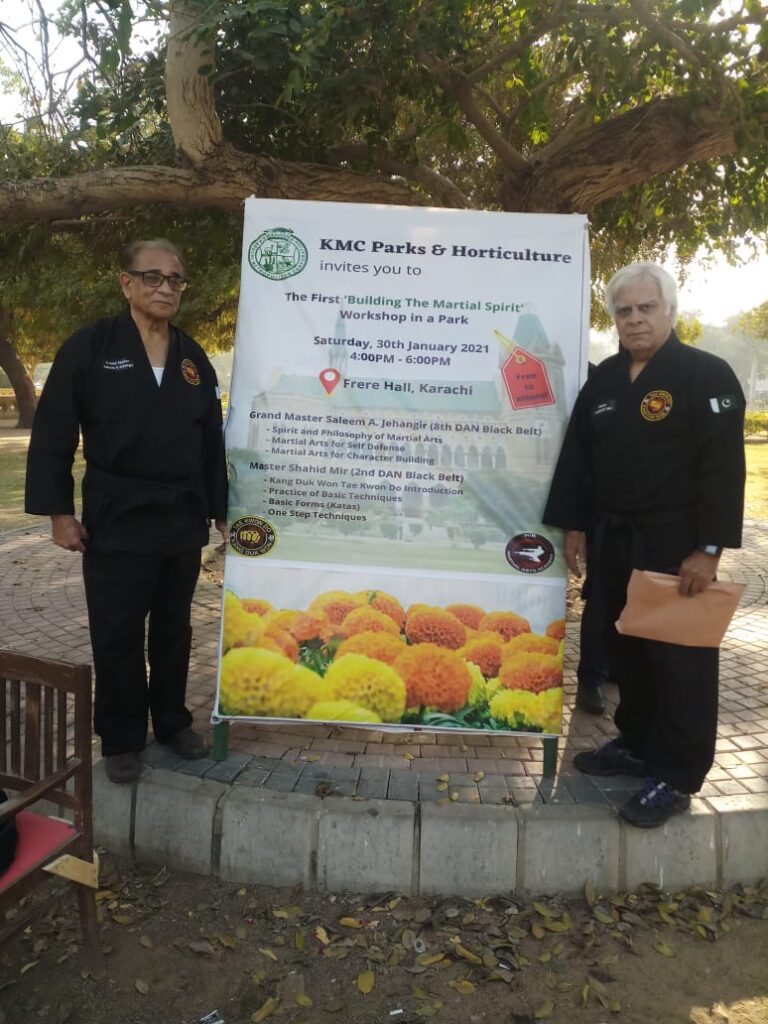
The Kangdukwon legacy in Pakistan
Jehangir’s work continued across subsequent generations. These later photographs record the national training network and public leadership that developed from the movement described in 1975.
Source: Richard Hirneisen, “Pakistan: Magic Carpets and Martial Arts,” Black Belt, December 1975. Archival scans supplied to the World Kangdukwon Federation.
Related: “Taekwondo has spread like wildfire in Pakistan” and “Hwa Chong, Great Master of Taekwondo.”